
Overview
ITQAN reworked a 90° offset mounting bracket that was made by casting or forging and then machining. A design for manufacturing and cost review showed that custom replacements made this way would be too expensive for the client.
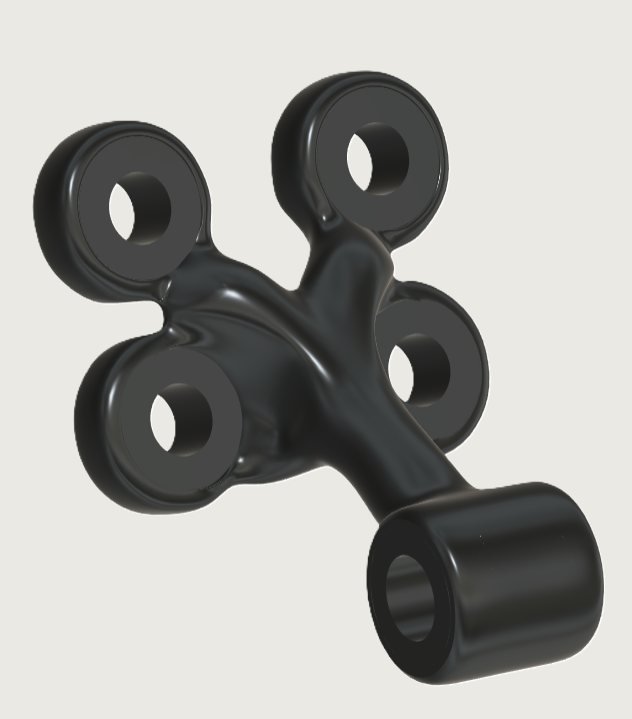
We redesigned the bracket for additive manufacturing in Autodesk Fusion 360. The optimized version is about 45% lighter, at 0.467 kg against 0.850 kg, and the titanium specified for production is roughly twice as strong as the cast iron it replaces.
- Sector
- Manufacturing and automation
- Design Method
- Generative, automated modeling
- Software
- Autodesk Fusion 360
- Prototype
- FDM, PLA
- Production Specification
- Grade 5 titanium (Ti-6Al-4V), DMLS
- Metal Printing
- Through our manufacturing partners
The Challenge: Tooling, Porosity and Dead Weight
Making this bracket by casting or forging, followed by finish machining, has three weak points, particularly for low volumes and custom replacements.
- Tooling and lead time. Casting needs multi-piece pattern tooling, and machining needs fixtures that can hold the non-prismatic offset geometry. Per-unit cost is high and lead times run to weeks.
- Porosity and stress risers. Cast parts can carry gas porosity and shrinkage voids in thick sections, especially where the curved arm meets the mounting flange. Sharp machined radii at the base add to the stress under cyclic bending and torsion.
- Extra weight. Casting needs draft angles and fairly uniform wall thickness. That rules out internal lattice and organic ribbing, so the bracket carries material in low-stress areas.
For a bracket that moves with the assembly, every gram of unnecessary mass is a cost.
Studying the Original Design
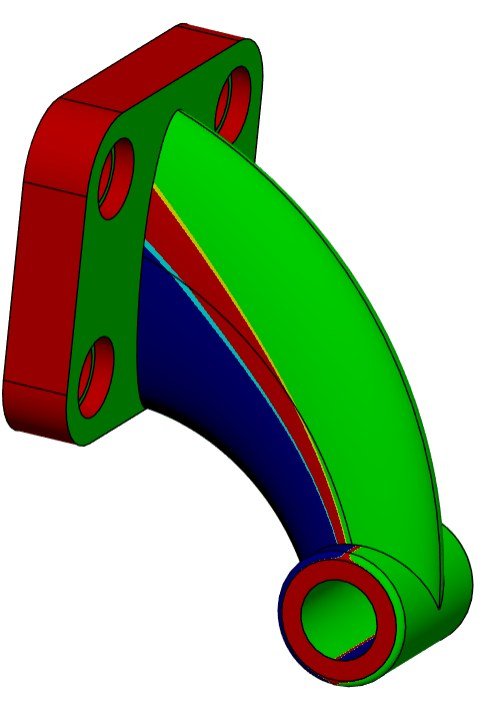
We reviewed the original bracket geometry for manufacturability before redesigning it. This colour-coded CAD view comes from that analysis.
Our Approach: Keep the Interfaces, Rebuild Everything Between Them
In Autodesk Fusion 360 we kept the critical interface geometry: the four-bolt mounting flange, the pivot pin bore and the structural contact faces. The space between them was opened up as a design envelope.
We applied static load cases that reflect real operation: the main pivot force, torsional loading from the chassis, and fastener preloads. An optimization algorithm removed low-stress material and reinforced the main load paths. The result is a web-like structure that spreads stress across the body and reduces local stress peaks.
That structure has internal undercuts and tool paths a 3-axis or 5-axis mill cannot follow. It is practical only as a layer-by-layer build.
Checking It in the Real Assembly
We printed both the original and the optimized bracket on an FDM printer in PLA and mounted them in the chassis assembly. This confirmed:
- Correct dimensional fit with the mating components and the existing frame clearances.
- Technicians can reach the fasteners with their tools during assembly.
- The lighter geometry is easier to work with in the assembly.
Choosing the Production Material
For the final part we specified Grade 5 titanium (Ti-6Al-4V) printed by direct metal laser sintering (DMLS), produced through our manufacturing partners.
- Strength for its weight. Typical yield strength of roughly 900 to 1,100 MPa at a density of 4.43 g/cm³. That is well above ductile iron and forged steel, at a fraction of the weight.
- Fatigue life and toughness. A pivot bracket sees repeated loading and vibration. Titanium's fatigue behavior and fracture toughness help resist crack growth over a long service life.
- No tool wear problem. Cutting solid titanium wears tools quickly and is costly. Printing builds a near-net-shape part directly, without specialist cutters or multi-axis fixtures.
- Post-print heat treatment. Vacuum stress-relief annealing and hot isostatic pressing (HIP) relieve residual stress and improve ductility and fatigue endurance.
Results
| Measure | Original Design | Optimized Design |
|---|---|---|
| Component mass | 0.850 kg | 0.467 kg (−45.1%) |
| Material strength | About 500 MPa | About 1,000 MPa (Ti-6Al-4V) |
| Manufacturing process | Casting or forging, then machining | Metal additive manufacturing (DMLS) |
| Tooling | Pattern tooling and machining fixtures | None required |
| Cost of low-volume replacements | High, due to tooling and setups | Lower, with no tooling |
Mass figures come from the CAD models. Strength figures are typical values for the materials, not test results from the finished bracket.
What This Means for the Client
By replacing casting and machining with optimization and additive manufacturing, the client avoids pattern tooling and machining fixtures entirely. A custom replacement becomes a printing job, and the bracket itself is lighter and built from a stronger material.
The same approach suits other cast or forged parts that are needed in small numbers and carry real loads.
More work
All Projects